- VIAC
-
ARBITRATION
- Arbitrate at VIAC
- VIAC eCase
- Combination of Arbitration and Mediation
- International Arbitration
- Resources
- NEWS & EVENTS
- Contact
-




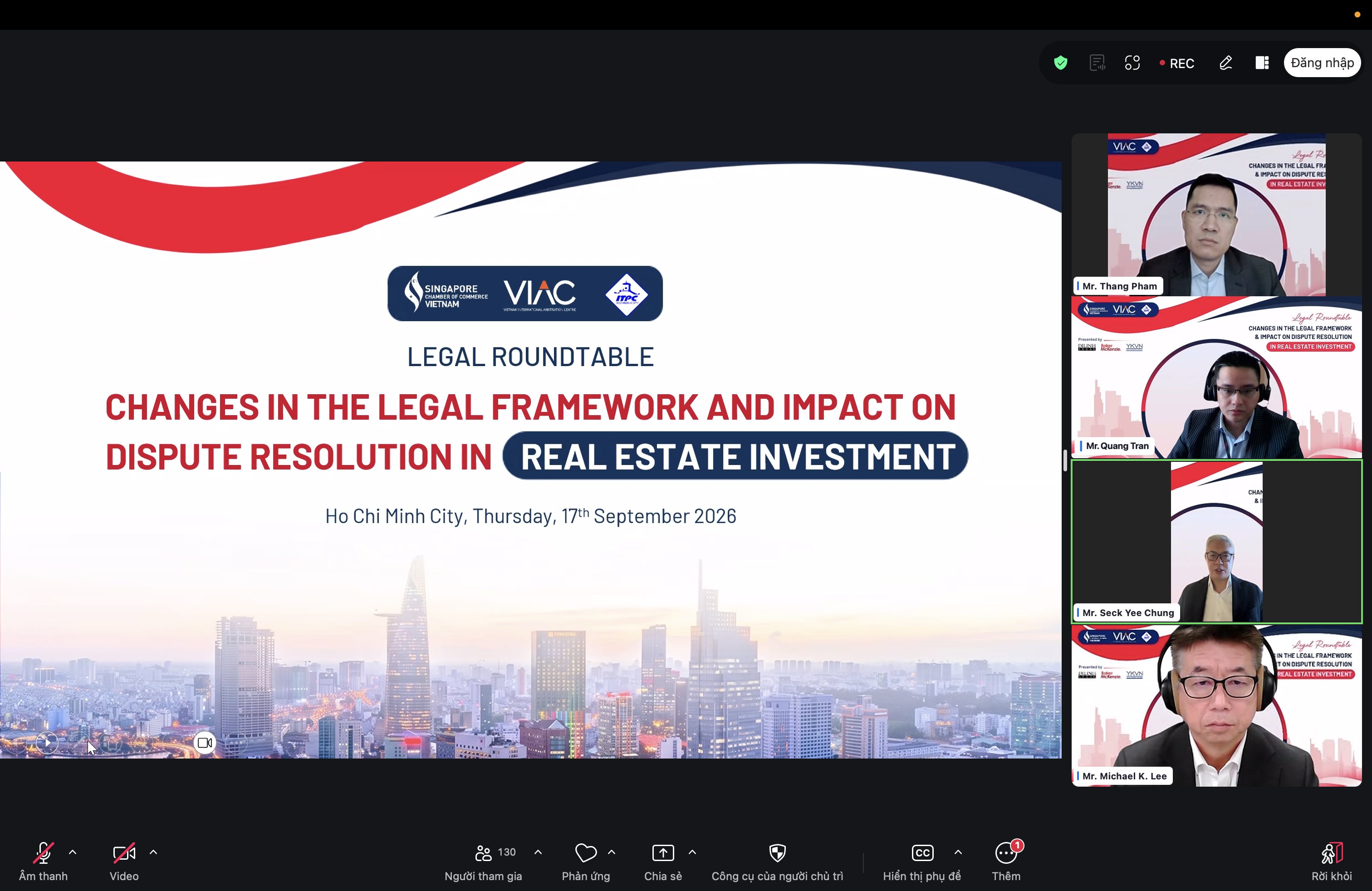
On the morning of September 17, 2026, the Vietnam International Arbitration Centre (VIAC), the Singapore Chamber of Commerce Vietnam (SingCham Vietnam), and the Investment and Trade Promotion Centre of Ho Chi Minh City (ITPC) co-organized an online Legal Roundtable titled “Changes in the legal framework & impact on dispute resolution in real estate investment”. The program attracted more than 150 participants, including business representatives, SingCham Vietnam members, lawyers, legal practitioners, and entities operating, investing, developing projects, or interested in the Vietnamese real estate market.
In the opening speech, Mr. Chau Viet Bac - Deputy Director of the Vietnam International Arbitration Centre (VIAC) - Ho Chi Minh City Branch cum Vice Secretary General of the VIAC Secretariat, presented notable figures from VIAC’s 2025 statistics. In 2025, VIAC registered 532 new disputes, nearly half of which involved foreign-invested enterprises and/or foreign elements; Singaporean parties also ranked among the nationalities with a significant presence at the Centre. Notably, real estate disputes accounted for approximately 20% of the total cases, making real estate one of the three largest dispute categories at VIAC, alongside sale of goods and construction. Drawing from dispute resolution practice, Mr. Chau Viet Bac observed that real estate is particularly vulnerable to shifts in the legal framework due to long project lifecycles, substantial capital commitments, and extensive regulation governing land, zoning and planning, licensing, financial obligations, and administrative requirements. Such changes can directly impact project costs, timelines, and original commercial assumptions, thereby giving rise to disputes between parties over risk allocation and the legal and economic consequences.
The session was moderated by Mr. Seck Yee Chung - Vice President of SingCham Vietnam, and featured three speakers: Mr. Michael K. Lee - Partner at Dilinh Legal, VIAC’s Listed Arbitrator; Mr. Pham Minh Thang - Partner & Head of the YKVN Singapore Office; and Mr. Tran Ngoc Thanh Quang - Senior Associate at Baker & McKenzie (Vietnam). The speakers focused on three key areas: (i) how contracts anticipate and allocate risks arising from changes in law; (ii) practical dispute management when such changes impact transaction execution; and (iii) the selection of appropriate dispute resolution mechanisms.
Changes in law should be treated as a distinct risk
Mr. Michael K. Lee - Partner at Dilinh Legal, VIAC’s Listed Arbitrator stated that a change in law should not be equated with force majeure. In his view, most policy and regulatory shifts do not render contract performance impossible; instead, they make projects costlier and cause delays. Therefore, when the law changes, parties need to remain flexible and adopt adaptation measures proportionate to the hardship or losses incurred by the project, rather than immediately terminating the contract.
On this basis, the speaker emphasized that the legal effect of a policy change depends on how the contract allocates risk rather than the title of the clause. A well-drafted clause must link the triggering event to the corresponding remedy. To achieve this, the parties should agree prior to execution on: (i) the reference date used as a baseline to identify subsequent changes; (ii) the scope and impact threshold that triggers an entitlement to claim; and (iii) notice procedures and evidentiary requirements.
Dispute realities across project stages
Following this presentation, Mr. Tran Ngoc Thanh Quang - Senior Associate at Baker & McKenzie (Vietnam), analyzed several practical cases across three project stages, corresponding to three relationships where disputes commonly arise: (i) between investors; (ii) between developers and contractors; and (iii) between developers and buyers.
Drawing from these cases, the Panel offered three recommendations for the parties:
Selecting dispute resolution mechanisms for real estate in Vietnam
Mr. Pham Minh Thang - Partner and Head of the YKVN Singapore Office, analyzed Article 470.1(a) of the Civil Procedure Code (2015), which provides that Vietnamese courts have exclusive jurisdiction over civil cases with foreign elements involving rights to properties being immovables (real estate) located in Vietnam. According to Mr. Thang, the phrase “involving” is relatively broad in scope, which in practice may affect the assessment of the validity of arbitration agreements, as well as the setting aside or recognition and enforcement of arbitral awards. In this context, clause 5, Article 236 of the Land Law (2024) has recognized that disputes arising from commercial activities relating to land may be resolved by Vietnamese courts or Vietnamese commercial arbitration. Mr. Thang further noted that determining jurisdiction should be based on the legal nature and subject matter of the specific claim, rather than merely on whether the transaction involves real estate.
Beyond jurisdictional considerations, the speaker also noted the availability of asset protection measures during dispute resolution proceedings. For actions such as freezing or prohibiting the transfer of land use rights, judicial assistance from Vietnamese courts can be essential. Consequently, the choice of dispute resolution mechanism and seat of arbitration is not merely a procedural consideration, but can directly impact the parties practical ability to preserve assets and protect their rights and interests.
Accordingly, Mr. Pham Minh Thang advised businesses to clearly determine the legal nature and subject matter of potential disputes from the transaction structuring phase, and to consider selecting arbitration seated in Vietnam for commercial contracts associated with land use rights or real estate assets in Vietnam. Furthermore, Mr. Thang noted that when drafting contracts, parties should explicitly articulate the commercial purpose and nature of the transaction alongside the dispute resolution mechanism. Designing dispute resolution clauses from the outset should be aligned with the overall deal structure, the availability of interim relief, and practical enforcement considerations, rather than being treated merely as a technical boilerplate clause at the end of the contract.
Following the presentations, the program proceeded with an interactive discussion and Q&A session with attendees, moderated by Mr. Seck Yee Chung. Participants raised numerous practical questions concerning the identification of risks arising from changes in law, the allocation of liabilities among parties during project execution, and the selection of suitable dispute resolution mechanisms for real estate transactions involving foreign elements. Drawing on specific scenarios, the speakers further discussed strategic approaches to contract drafting, evidence management, the choice of arbitration, and measures to ensure practical enforceability.


![[Recap LMS 2026] Business Legal Lens (BLL) #02: “Force majeure: The gap between business understanding and legal approach”](/images/News-and-Events/2026/News/LMS 2026/BLL02/IMG_0136.jpg)
![[Recap LMS 2026] VIAC & ITPC co-organized the Business Legal Lens (BLL) #01: “Conditions precedent in loan agreements: Understanding correctly to prevent risks”](/images/News-and-Events/2026/News/LMS 2026/BLL 01/IMG_8873.jpg)
![[Recap LMS 2026] Talkshow “Exemption from liability for technology-related risks in logistics transactions”](/images/News-and-Events/2026/News/LMS 2026/Logistics/LMS2026_2708---Slideshow-1.jpg)
![[Recap LMS 2026] Talkshow “Commercial contracts with counterpart clauses – Streamlining contract formation or increasing legal risks?"”](/images/News-and-Events/2026/News/LMS 2026/Thuong mai/LMS2026_2008_Speakers.png)
![[Recap LMS 2026] Talkshow “Arbitral jurisdiction in resolving disputes arising from digital financial transactions"](/images/News-and-Events/2026/News/LMS 2026/Tai chinh/LMS2026_260813__Backdrop.png)



.png "Trường đại học ngoại thương")