- VIAC
-
ARBITRATION
- Arbitrate at VIAC
- VIAC eCase
- Combination of Arbitration and Mediation
- International Arbitration
- Resources
- NEWS & EVENTS
- Contact
-




On the afternoon of July 17, Ms. Vu Thi Hang – Chief and Deputy Secretary General of Secretariat at VIAC – has joined and delivered her insightful perspectives on “Dispute Resolution by Arbitration in Vietnam: A 2026 Update for Investors and Businesses” at “Structuring Investments and Navigating Disputes: A Vietnam Investment Masterclass”, an event hosted by A&G Asia in collaboration with Vietnam International Arbitration Centre (VIAC) and Singapore Chamber of Commerce Vietnam (SingCham Vietnam).
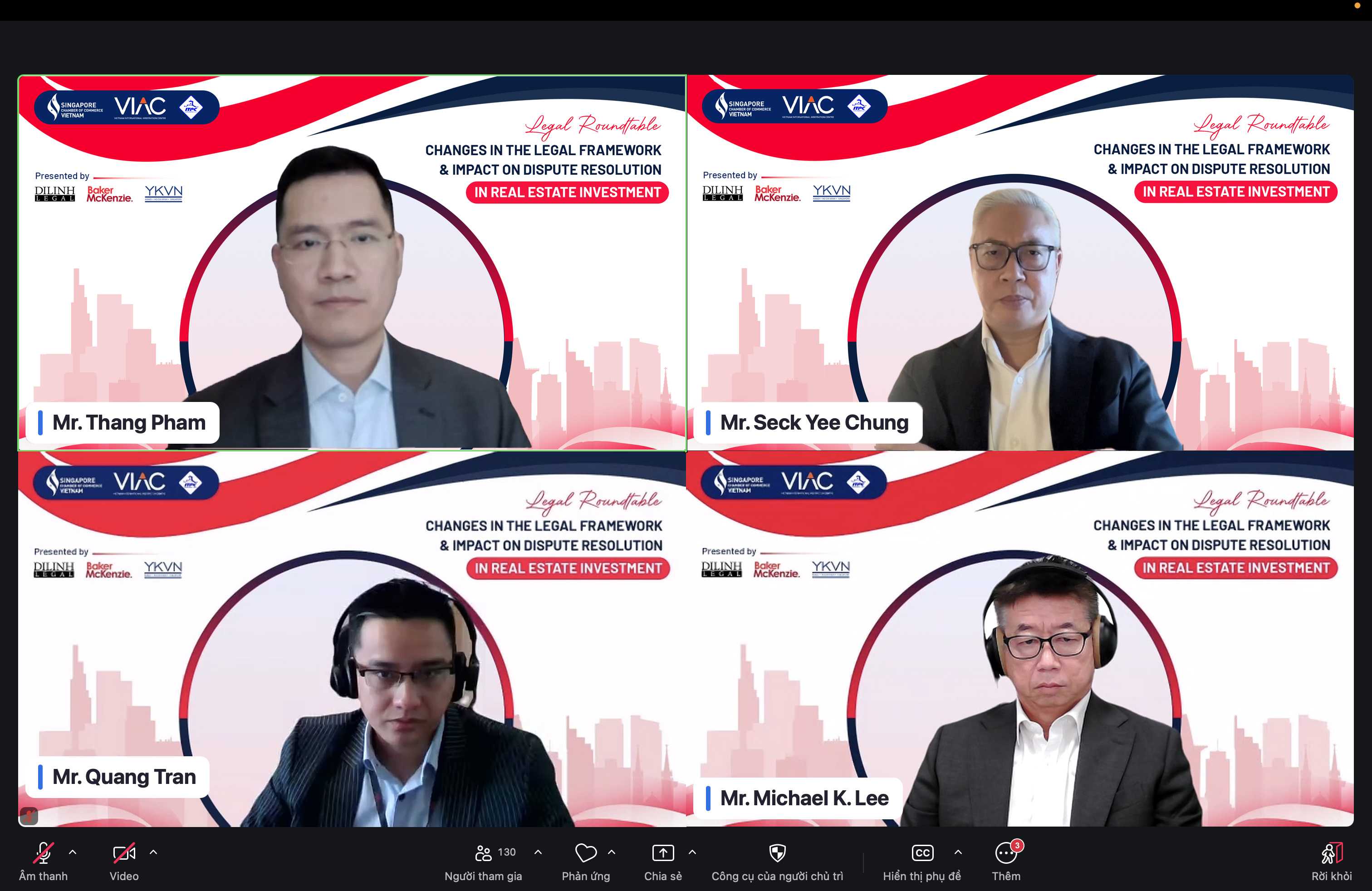
Successfully held on 17 July 2026 in Ho Chi Minh City, the “Structuring Investments and Navigating Disputes: A Vietnam Investment Masterclass” brought together legal practitioners, experts, investors and businesses to discuss practical issues surrounding investment protection and dispute management in Vietnam. The programme focused on three key themes: (i) Commercial Dispute Resolution in Vietnam: Recent Developments and Practical Considerations for Investors; (ii) Structuring Investments in Vietnam: Minimising Risk and Avoiding Disputes; (iii) Key Trends in Investor-State Arbitration.

Overview of the event
Representing VIAC, Ms. Vu Thi Hang – Chief and Deputy Secretary General of Secretariat at VIAC, delivered a presentation titled "Dispute Resolution by Arbitration in Vietnam: A 2026 Update for Investors and Businesses". She opened with an overview of Vietnam's investment landscape, drawing attention to both the scale and the growing complexity of investment activity, and to the economic and transactional opportunities that the coming wave of major infrastructure and energy projects will bring (i.e. high-speed rail, transport and logistics networks, and projects under Power Development Plan VIII. etc.). These developments are giving rise to increasingly complex and cross-border contractual structures involving supply agreements, construction packages, financing arrangements, joint ventures, and share acquisitions. As investment activity continues to expand, choosing an appropriate dispute resolution mechanism and arbitral forum from the outset is becoming an increasingly important consideration for investors.
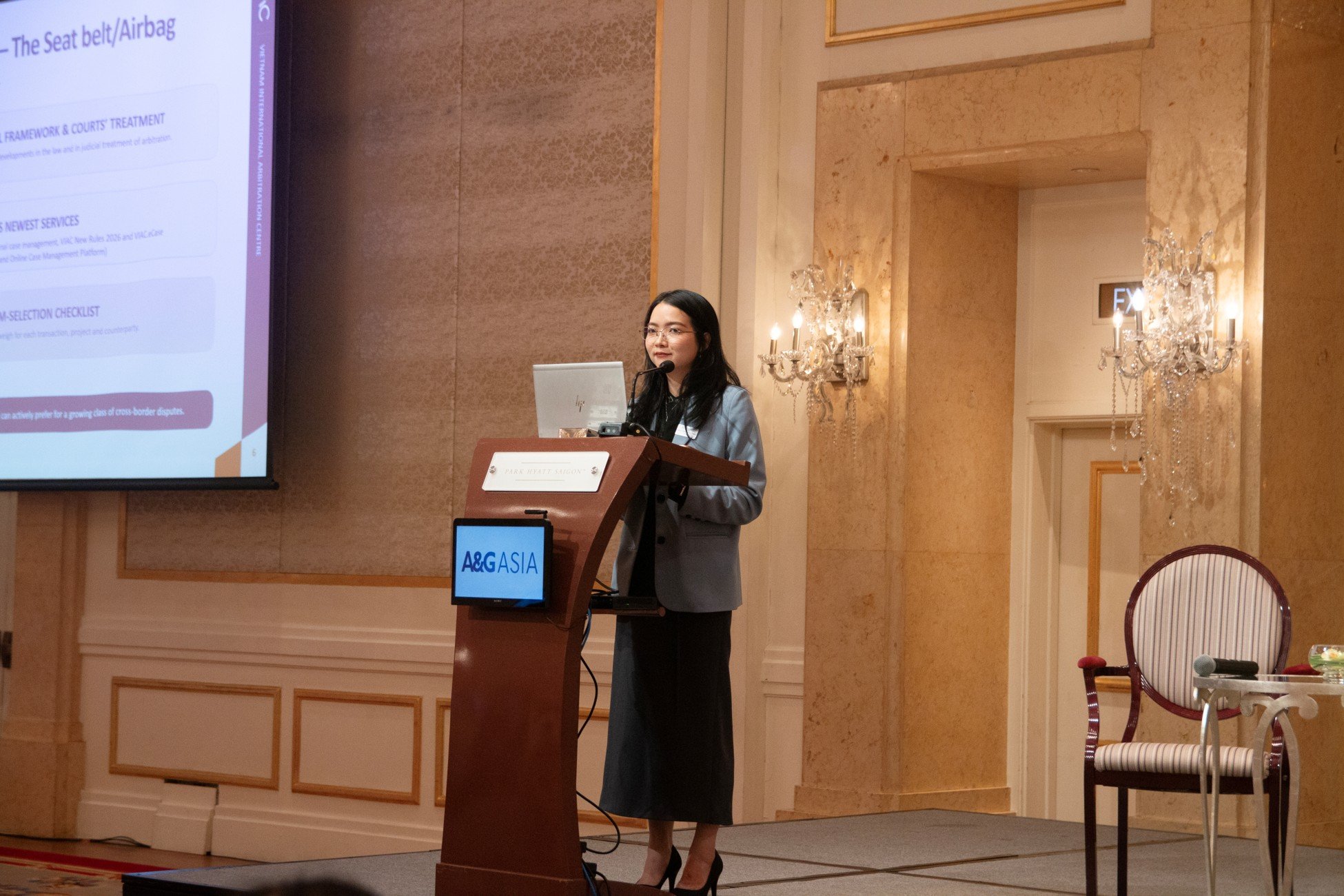
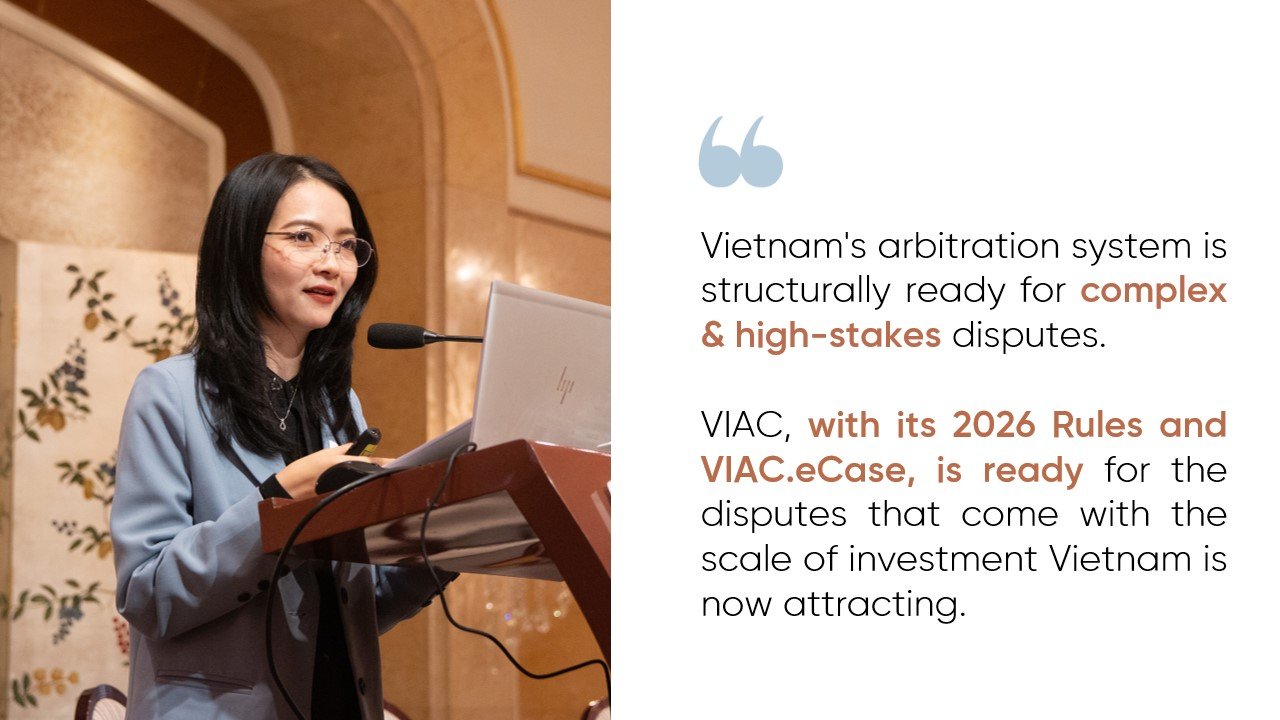
Ms. Vu Thi Hang shared her perspectives on “Dispute Resolution by Arbitration in Vietnam: A 2026 Update for Investors and Businesses”
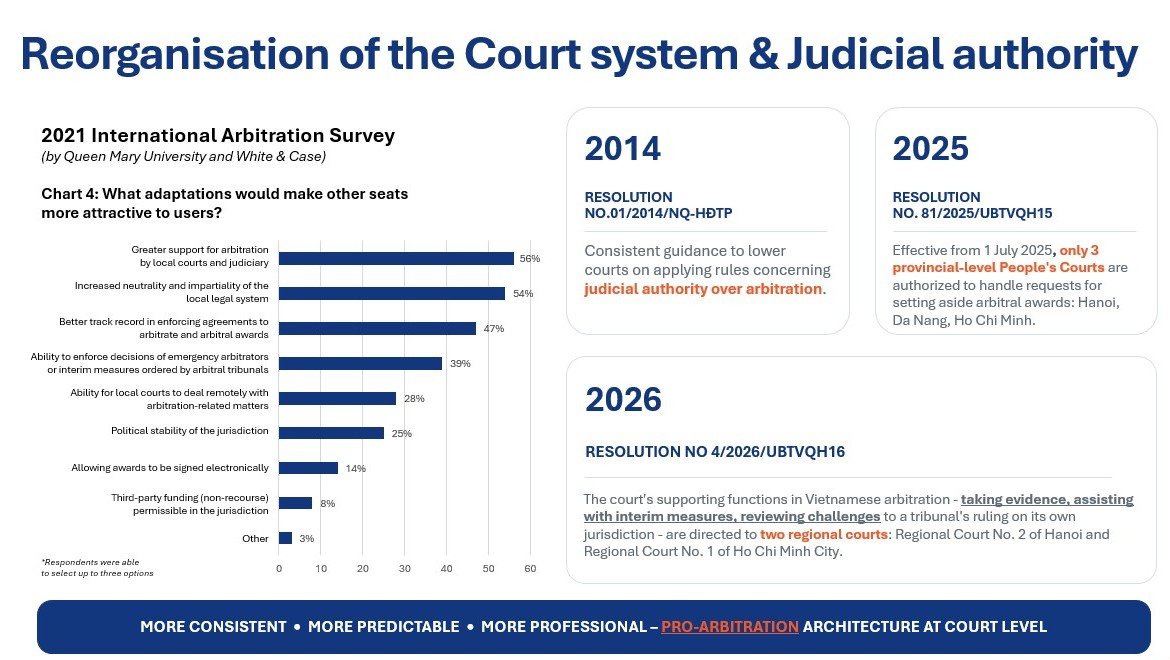
On the judicial side, Hang highlighted several recent developments in the court’s support for arbitration in Vietnam. Alongside with Resolution No.01/2014/NQ-HĐTP of the Council of Justices of the Supreme People’s Court providing guidance to promote the consistent application of rules governing the courts’ supervisory and supportive roles in arbitration, the Resolution No.81/2025/UBTVQH15 (effective from 1 July 2025) and more recently, the Resolution No.04/2026/UBTVQH16 have further strengthened judicial specialization, centralising jurisdiction over applications to set aside domestic arbitral awards and judicial support Vietnam-seated arbitration proceedings in just three major courts: the People’s Courts of Hanoi, Da Nang, and Ho Chi Minh City. This concentration of judicial authority is believed to improve consistency, predictability, and professional expertise in arbitration-related matters, reflecting an increasingly pro-arbitration judicial architecture in Vietnam.
Turning to institutional readiness, VIAC’s strong track record is pointed as a sign of growing trust in VIAC, noting that cases involving foreign elements and FDI parties now account for roughly half of its annual caseload.
Hang singled out two major developments supporting VIAC’s capacity to administer increasingly complex disputes consist of:
First, the VIAC Rules of Arbitration 2026, effective from 1 July 2026, mark a shift towards a more modern and institutionally managed framework aligned with international best practices. The Rules introduce clearer mechanisms for multi-contract disputes, consolidation, joinder (additional parties), and expedited proceedings, while strengthening procedural efficiency and coherence in complex cases.
Second, the VIAC.ECase – the VIAC’s integrated platform for electronic filing and online case management. By streamlining document submission, case tracking, procedural deadlines, and communications, the platform is designed to enhance the user experience while improving the time and cost efficiency of arbitration proceedings.
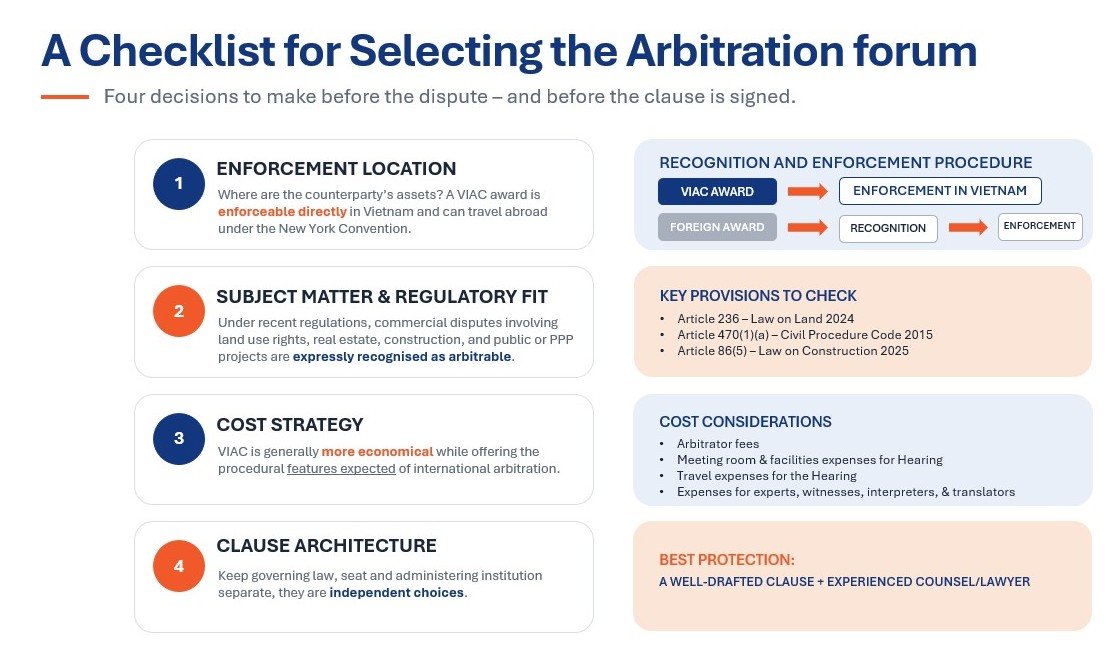
On the practical side, Hang offered investors a four-part checklist for selecting an arbitral forum including the likely place of enforcement, subject-matter arbitrability, cost strategy, and the structure of arbitration clause. The right choice, she suggested, turns on where the parties and their assets are located, the nature of the underlying transaction, and any applicable statutory requirements. For transactions involving land-use rights, real estate, construction, public projects, or PPP arrangements in Vietnam, the choice of a Vietnamese arbitral institution may offer important legal and enforcement advantages. She also stressed that the governing law, the seat of arbitration, the arbitral institution (administering institution), and the hearing venue are separate and independent choices, each deserving careful consideration rather than being folded into a single decision. Hang closed with a simple message was that Vietnam’s arbitration system is structurally ready for complex & high-stakes disputes. VIAC, with its 2026 Rules and VIAC.eCase, is ready for the disputes that come with the scale of investment Vietnam is now attracting.
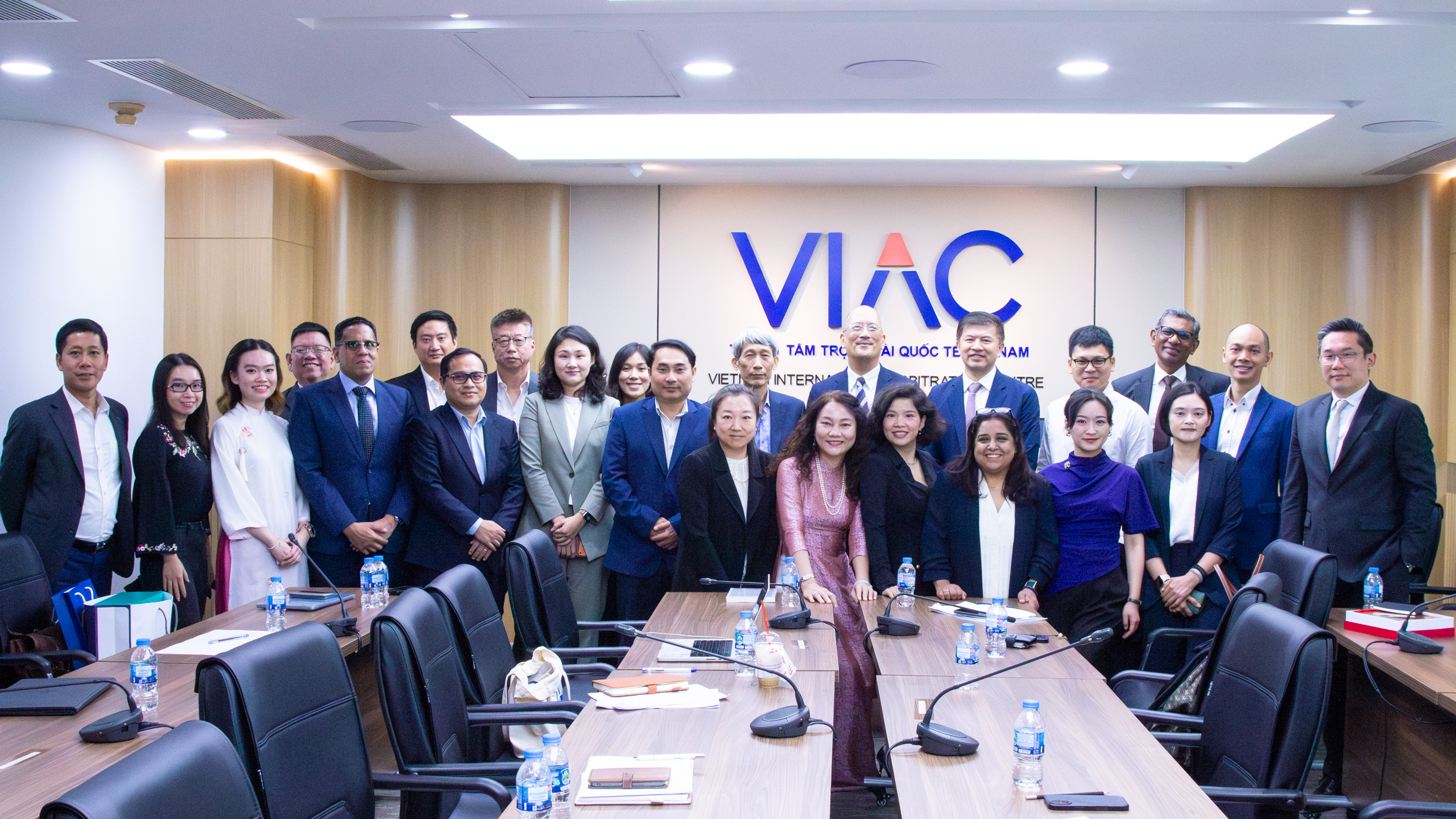
The Investment Masterclass concluded with high-value practical insights for foreign investors navigating Vietnam’s evolving legal landscape. Beyond substantive legal discussions, the event facilitated strategic networking and constructive dialogue between legal practitioners, experts, investors and business leaders, thereby contributing to a more transparent and arbitration-friendly ecosystem and reinforcing confidence in Vietnam’s long-term investment prospects.


![[Recap LMS 2026] Business Legal Lens (BLL) #02: “Force majeure: The gap between business understanding and legal approach”](/images/News-and-Events/2026/News/LMS 2026/BLL02/IMG_0136.jpg)
![[Recap LMS 2026] VIAC & ITPC co-organized the Business Legal Lens (BLL) #01: “Conditions precedent in loan agreements: Understanding correctly to prevent risks”](/images/News-and-Events/2026/News/LMS 2026/BLL 01/IMG_8873.jpg)
![[Recap LMS 2026] Talkshow “Exemption from liability for technology-related risks in logistics transactions”](/images/News-and-Events/2026/News/LMS 2026/Logistics/LMS2026_2708---Slideshow-1.jpg)
![[Recap LMS 2026] Talkshow “Commercial contracts with counterpart clauses – Streamlining contract formation or increasing legal risks?"”](/images/News-and-Events/2026/News/LMS 2026/Thuong mai/LMS2026_2008_Speakers.png)
![[Recap LMS 2026] Talkshow “Arbitral jurisdiction in resolving disputes arising from digital financial transactions"](/images/News-and-Events/2026/News/LMS 2026/Tai chinh/LMS2026_260813__Backdrop.png)



.png "Trường đại học ngoại thương")